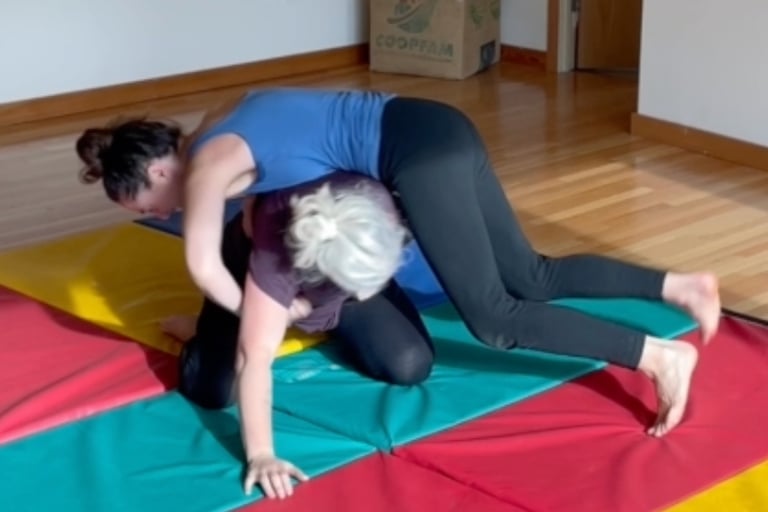
Humans need physical contact with other humans. This core human need can be challenging to fulfill in our modern culture of screens and separation. Many people suffer from touch deprivation, possibly without even knowing what they are missing.
This was my experience growing up in a household where touch was not something we did. When, in my early 20s, I heard a story about a friend who had whole family hugs, I laughed like that was the craziest thing I had ever heard. I truly believed my experience was normal, and that family hugs were crazy. It’s amazing what we can get used to.
There is also the case where people have been hurt or overwhelmed by physical contact. This can create chronic feelings of tension and discomfort around being close with other people.
The good news is, it’s never too late to discover how great it feels to be squished by another human.
How Haven Jiu Jitsu Supports Safe Physical Contact
Jiu Jitsu offers a structured environment to explore physical contact. The clearly defined rules (such as no striking) are solid boundaries that help us feel safe. Haven Jiu Jitsu brings a new, trauma-informed approach to training, where consent and communication are foundational.
Participants choose:
the level of intensity they want to play with
how much contact they want
when to pause
when to switch roles
This choice-based structure aligns with research showing that agency during physical contact is essential for trauma healing.
The Healing Power of Fighting
Regular, intentional physical contact fulfills a basic human need with measurable benefits: lower stress, better emotional regulation, and stronger social bonds. For people who feel uncomfortable with physical touch, learning to fight can provide a way to feel safe in the experience of physical closeness. This might sound strange, but it makes sense when we look through the lens of polyvagal theory.
Psychologist Deb Dana uses the image of a ladder to explain the three states of the nervous system. At the top is ventral vagal, the state of safety, connection, and presence. When we feel regulated, grounded, and socially open, we’re “at the top of the ladder.” The middle step is sympathetic activation, often called fight-or-flight. This is the state of mobilization and intensity. At the bottom of the ladder is dorsal vagal, the shutdown or collapse state. This is where we feel numb, disconnected, frozen, or overwhelmed. Dana explains that in order to move from the low vibes of dorsal vagal to the high vibes of ventral vagal, we need to move through the middle step of sympathetic activation. We can't skip this step. It can be easy to get stuck in shutdown mode when we avoid physical confrontation. By engaging in safe, playful, intentional Jiu Jitsu training, we can start to build trust in the process of of moving from freeze to fight to freedom.
In a distant, digital world, safe physical contact can be hard to find. Jiu Jitsu training offers a way to rediscover how it feels to be a full human.
Ready to give it a try? Come check out a class!
See you on the mats,
Haven